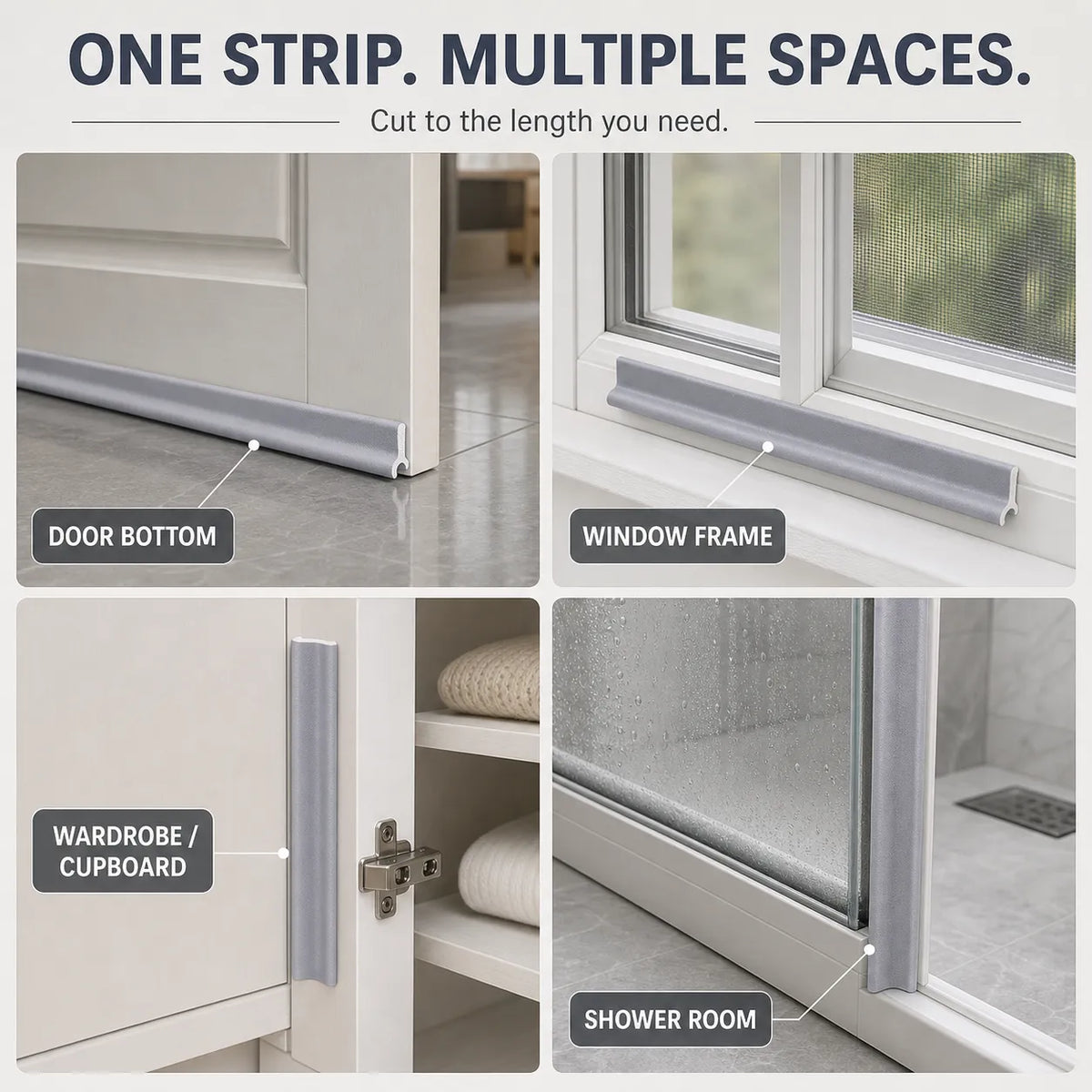
The Foam Strip That Quiets the Draft Your Door Keeps Letting In
Self-adhesive weather seal that closes gaps up to 5 mm on doors and windows.
A rolled towel blocks a draft for a few weeks, then slides and stains the threshold. This foam strip lines the edge of a door or window so the movable gap closes cleanly — the cold stops coming through, and so does the whistling on a windy night.

A towel at the door is not the same as a sealed gap
You notice the cold floor first, then the whistle on a windy night, then the January bill that does not match how much you actually heated the place. A towel blocks the worst of it for a while, but it slides, it marks the threshold, and the draft returns the moment you lift it.
Caulk is the proper fix and, for most of us, a project we keep deferring. The strip, by contrast, is a Saturday morning: measure, cut, peel, stick, and the door stops breathing for the rest of the season. The gap does not care how long you wait — it keeps costing you.
The usual options all trade something away. Silicone caulk is permanent and messy. Felt strips crush flat and stop sealing. A door sweep helps the bottom but not the sides. Foam strip takes the sensible line: removable, clean, and sized for the gaps older frames actually have.

What the seal strip actually does
A foam strip with pressure-sensitive adhesive lines the edge of a door or window so the moving gap closes on contact. The foam compresses as the door shuts and recovers as it opens, so the draft you felt walking past is gone — replaced by a steadier room and a quieter one.
It is sized for a 2 to 5 mm gap, the range most settled doors and older windows actually fall into. A full door takes under ten minutes with scissors and a dry cloth, and the adhesive lifts off cleanly when you swap the strip next year.

Why it stays in the utility drawer
1Adhesive that lasts the year
The pressure-sensitive backing grips clean, dry surfaces and holds through cold mornings and humid summers alike.
2Cut with house scissors
No special blade, no mitering. Trim to the frame and the next strip starts where this one ends.
3Fills 2 to 5 mm gaps
The foam thickness sits in the gap range most older frames and settled doors really have.
4Peels off without residue
When the season ends you lift the strip and the frame is clean, ready for the next roll.
5Quiets noise too
A closed foam seal blocks the air gap that carries both cold drafts and street sound through the same opening.

Who keeps a roll nearby
Anyone in an older house, a flat with a drafty front door, or a room that never quite reaches the thermostat. Home-office workers notice next: a thin strip along the window edge removes the cold and the mid-afternoon street noise that arrive through the same gap.
Keep a roll in the utility drawer so the next cold snap is a ten-minute job, not a weekend of caulking.
How to fit the strip
Wipe the frame dry, peel about 15 cm of backing at a time, and press the foam to the stop — not the face — so the door closes against the foam instead of past it. Trim at the end, close up, and run a hand along the seal; if you feel air, nudge the foam toward the weather side.
Apply it to clean, dry, cured paint. On wallpaper or textured plaster, test a short length first. It is a draft fix, not a substitute for damaged exterior weatherproofing.
Add to Cart
What homeowners are saying
A
Alan V.
★★★★★ · Example review
A 1940s front door with a gap you could see daylight through. One roll along the stop and the draft that pooled on the floor is just gone. Took about a coffee.
N
Nora K.
★★★★★ · Example review
The office window whistled every time the wind came from the west. Foam on Saturday, the noise left with it. Quiet at the desk again.
C
Carlos D.
★★★★★ · Example review
Best part — it comes off without gumming the paint. I rent and I hate sticking anything permanent. This pulls back clean at season end.
P
Priya S.
★★★★★ · Example review
Five meters did the front door and the bedroom window. Held through a humid August and a cold November. Replacing it next year is the only upkeep I want.
Questions people ask
What is the widest gap it seals?+
The foam takes up gaps from about 2 mm to 5 mm. Wider and the door will not close; narrower and it will not compress enough to seat.
Will it mark the paint?+
On clean, fully cured paint it lifts off with no residue. On wallpaper or textured plaster, test a short section first.
Can I use it on a sliding door?+
Yes — apply it to the stop the panel closes against, not the track. It seals any door that shuts against a fixed frame.
What temperatures can it take?+
The foam and adhesive together cover about −10 °C to 60 °C, which covers normal home use either way.
How long does one fitting last?+
On a clean interior door most people get a full year before they want to replace it. Busy doors wear faster and are cheap to redo.
Does it help with sound or just draft?+
Both. A closed foam seal blocks the air gap that carries sound as well as cold, so the room usually gets quieter along with warmer.
Foam strip vs. other draft fixes
| Aspect |
This Product |
Loose ideas |
| Install time |
10 minutes per door |
Half a day or more |
| Tools |
Scissors and a cloth |
Caulk gun, knife, tape |
| Finish |
Thin line on the stop |
Bead of caulk, visible |
| Replacing |
Peel and re-stick |
Scrape and redo |
| On the frame |
Comes off clean |
Can mark the paint |
Specifications
| Specifications |
Details |
| Length |
5 m per roll |
| Width |
9 mm |
| Thickness |
4 mm (fills 2 – 5 mm gaps) |
| Colors |
Gray, White, Brown, Black |
| Material |
Closed-cell PE foam + PSA |
| Temperature |
−10 °C to 60 °C |
| Best for |
Interior doors, windows, settled frames, sound |
Add to Cart
Every roll is checked before dispatch. This strip is for indoor drafts and sound on movable frames, not a substitute for damaged exterior weatherproofing. Apply to clean, dry, cured surfaces.