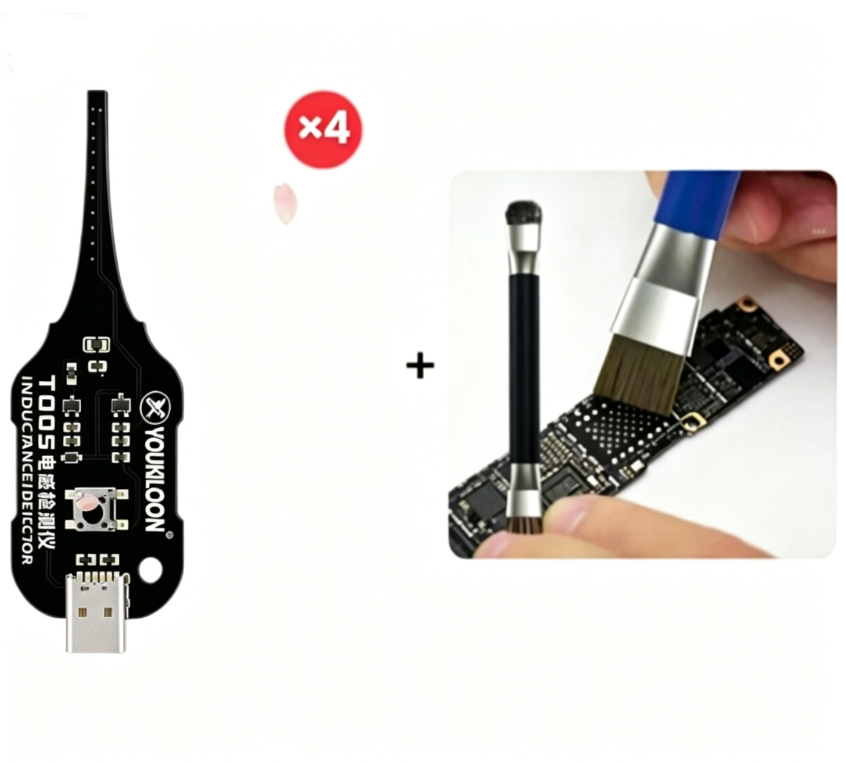
The One-Button Inductance Tester for In-Circuit Checks
A non-contact diagnostic tool for finding faulty inductors without desoldering
Power the tester by USB-C, keep the circuit board switched off, and use the visual indicator to check inductors directly on the board. Simple enough for hobby work, useful enough for repair benches.

The fault is often hidden in the board
A board can look clean and still contain an inductor that is no longer performing correctly. Desoldering every suspect component takes time, risks lifting pads and turns a simple diagnostic into a larger repair.
A multimeter may not give the in-circuit answer you need, and a complicated bench setup is not always available at the workbench. When you need a quick direction, a small tester with a clear visual response can help you decide what to investigate next.
The ordinary options each have a trade-off. Visual inspection finds obvious damage but misses hidden electrical faults. Desoldering is thorough but adds time and risk to the board. A complex tester may be accurate but slow to set up. This tool focuses on one job: a quick, non-contact in-circuit check of inductors.

What this inductance tester actually does
It uses electromagnetic induction testing to check inductor functionality directly on a circuit board without desoldering. A visual indicator helps you identify a suspected fault, while one-button operation keeps the setup simple.
The compact ABS and circuit-board unit measures 35 × 88 × 13 mm and weighs about 80 g. It is powered by USB-C, which is not included, and the board under test must be completely powered off before you begin.

Five details for a cleaner diagnostic workflow
1Non-contact in-circuit testing
Check inductors directly on the board without removing each component first. That can preserve the board and reduce unnecessary handling.
2Quick visual fault finding
A clear visual indicator gives immediate feedback so you can focus attention on the suspected inductor and continue the repair workflow.
3One-button operation
The simple control avoids a complicated setup, making it approachable for technicians and hobbyists who need a focused tool.
4High-precision detection
The tester is designed to identify small performance deviations in inductors and support more informed repair decisions.
5Stable repeatable performance
A stable electronic architecture is designed to provide consistent diagnostic results from one test to the next.

Who tends to keep one on the repair bench
This is for electronics technicians, repair shops, makers and hobbyists who work with circuit boards and want a fast first check before desoldering components. It is compact enough for a tool case or a bench drawer.
Use it when a board powers down for diagnosis and an inductor is suspected. It is a focused instrument, not a replacement for a complete electronics test setup, so combine its result with the rest of your troubleshooting process.
How to use it safely
Make sure the circuit board is completely powered off. Supply the tester through USB-C with a compatible cable and use the one-button control to check the inductor directly on the board. Watch the visual indicator and compare the result with your troubleshooting context.
The tool is designed for in-circuit inductor testing. Do not test a powered board, do not treat a single indication as a complete diagnosis and keep the USB-C connection and work area controlled during repair.
Add to CartWhat customers are saying
D
Derek L.
★★★★★ · Example review
The one-button layout is easy to understand. I use it as a first check before deciding whether a component needs to come off the board.
M
Mina P.
★★★★★ · Example review
It is small enough to keep in the electronics drawer and the visual indicator is easier to follow than a complicated bench setup.
A
Alex W.
★★★★★ · Example review
Useful for quick in-circuit checks during hobby repairs. I appreciate that the instructions clearly say to power the board off first.
J
Jordan S.
★★★★★ · Example review
The tester has one focused job and does not take much space. It helps me narrow down where to look before doing a larger repair.
Questions people ask
What does it test?+
It is designed to test the functionality of inductors directly on a circuit board using electromagnetic induction.
Do I need to desolder the inductor?+
No. It is intended for non-contact in-circuit diagnostics, so the inductor can be checked without desoldering it first.
Must the circuit board be powered off?+
Yes. The board must be completely powered off before testing. This is an essential safety step.
How is the tester powered?+
It requires power through USB-C. The USB-C cable or power supply is not included, so use a compatible source.
What are the dimensions?+
The tester measures 35 × 88 × 13 mm and has a listed net weight of about 80 g.
Does one result replace full diagnosis?+
No. It is a focused inductor-checking tool. Use its indication together with other appropriate troubleshooting methods before replacing components.
This tester vs ordinary fault-finding steps
| Aspect |
This Product |
Ordinary |
| Contact |
Non-contact in-circuit check |
Desoldering required |
| Control |
One-button operation |
Complex setup |
| Feedback |
Visual indicator |
May require interpretation |
| Workflow |
Quick first check |
Longer diagnosis |
| Form |
35 × 88 × 13 mm |
Larger bench equipment |
| Power |
USB-C supply |
Varies by instrument |
Specifications
| Specifications |
Details |
| Color |
Black |
| Dimensions |
35 × 88 × 13 mm |
| Net weight |
80 g |
| Material |
ABS and circuit board |
| Power |
USB-C, not included |
| Testing |
In-circuit electromagnetic induction |
| Package |
1 × in-circuit electromagnetic inductance tester |
| Safety |
Test only when the board is completely powered off |
Every product is inspected before dispatch. This is a focused diagnostic aid, not a complete test system. Power the circuit board off before testing and use a compatible USB-C supply.